Web Development Guides
Freelancer vs Agency for Your Website: How to Choose the Right Fit
Freelancer or agency for your website? Compare cost, skills, risk and support, the questions to ask both, and the warning signs to watch before you hire.
Dev Artistry Hub6 min read
In this article — 8 sections
A freelancer is usually the better fit when the job is clear, the scope is small to medium, and you want to talk directly to the person doing the work. An agency is usually the better fit when the project needs several skills at once (strategy, design, development, copy, SEO), has a fixed deadline you cannot miss, or will need steady support after launch.
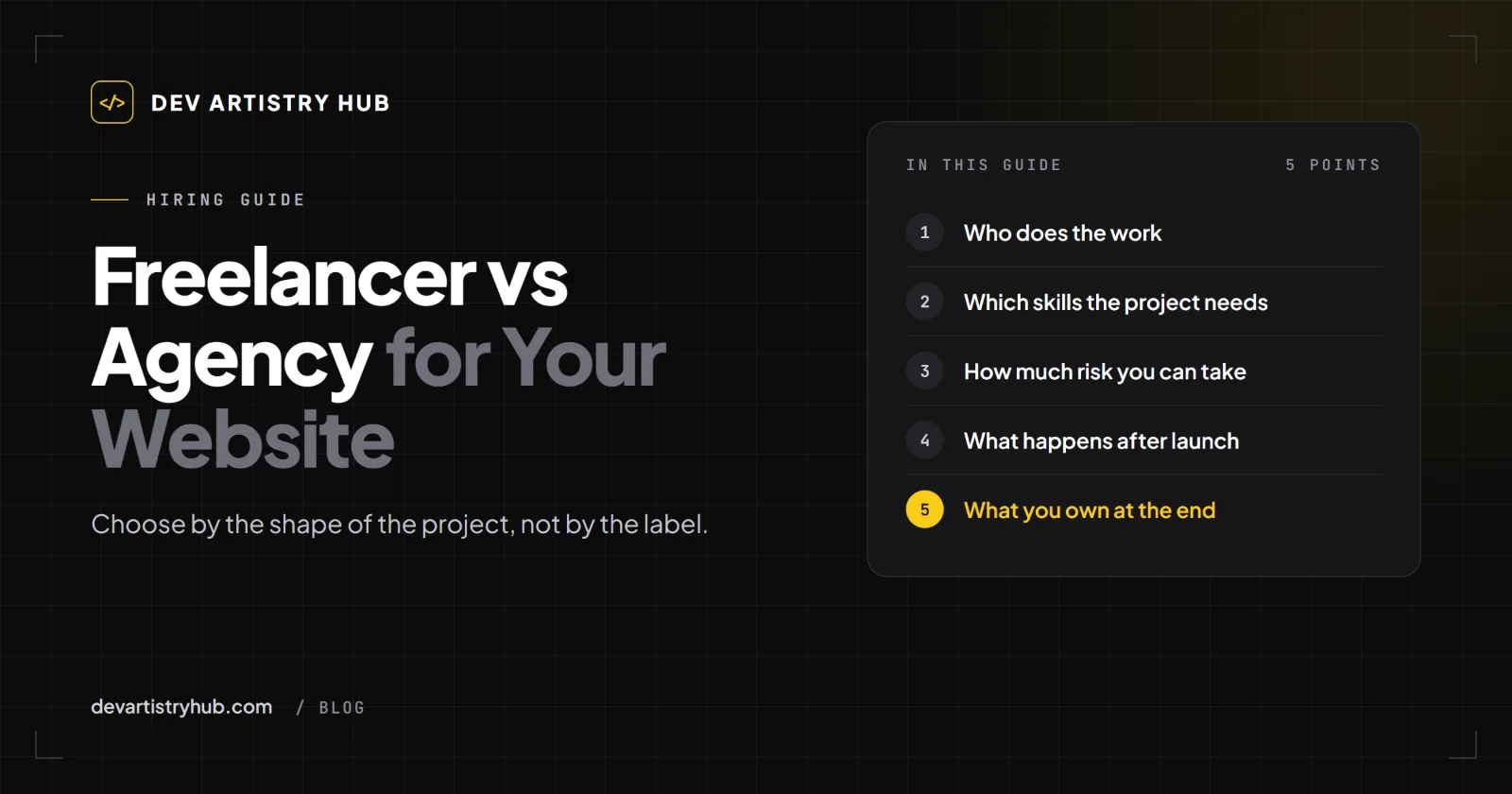
In short: choose by the shape of the project, not by the label. A small studio can work like a focused freelancer, and a strong freelancer can bring in help like a small agency. What matters is who does the work, who answers when something breaks, and what you own at the end.
What You Are Really Choosing Between
The words "freelancer" and "agency" cover a wide range. A freelancer can be a new developer taking their first paid project or a specialist with ten years in one platform. An agency can be a 200-person firm or a three-person studio.
So instead of comparing labels, compare these five things:
- Who does the work. Will the person you speak to on the call build your site, or hand it to someone you never meet?
- Which skills the project needs. A landing page needs one or two skills. A store redesign with new branding, product photography and a migration needs five.
- How much risk you can take. If one person gets sick for two weeks, does your launch move?
- What happens after launch. Updates, fixes and small changes do not stop on launch day.
- What you own. Logins, the domain, the hosting account, the design files and the code.
When a Freelancer Makes More Sense
A good freelancer is often the fastest and most direct option. You explain the problem to the person who will solve it, and nothing gets lost between a salesperson, a project manager and a developer.
A freelancer tends to fit well when:
- The scope is clear. You already know what you need: fix a WordPress error, turn a Figma file into a site, add a section to a Shopify theme.
- One main skill is needed. The job is mostly development, or mostly design, not both plus marketing.
- Your budget is limited. There is less overhead to pay for, so you are mostly paying for the hours of work.
- You want to be involved. You are happy to give feedback often and make decisions quickly.
The trade-off is capacity. One person can only be in one place at a time. If they are ill, on holiday or busy with another client, your project waits. Ask how they handle that before you sign.
When an Agency Makes More Sense
An agency earns its higher price when the project is bigger than one person's skills or one person's calendar.
An agency tends to fit well when:
- Several skills are needed together. Planning the structure, designing the pages, building them, writing copy and setting up search basics.
- The deadline is fixed. A launch tied to a product release, an event or a funding round needs cover if one person is unavailable.
- You need ongoing support. Monthly updates, backups, security checks and small changes are easier to hand to a team with a process.
- Several people on your side need to be kept informed. Agencies are used to reporting to a marketing lead, a founder and a finance person at once.
The trade-off is distance. In a large agency you may never speak to the developer. Ask to meet the people who will actually work on your site.
Cost: What You Are Paying For
Prices vary too widely by country, platform and project size for a single honest number. What you can compare is what each quote includes.
When you collect quotes, put them side by side and check:
- Is the price fixed or hourly? A fixed price for a defined scope protects you from surprises. An hourly rate is fair for open-ended work, as long as you get a cap or a regular estimate.
- What is included? Design, development, content entry, testing on real phones, basic SEO setup, training and a period of free fixes after launch are often listed separately.
- What costs extra later? Hosting, premium plugins or apps, theme licences and monthly maintenance.
- How are changes handled? Every project changes. A clear change-request process is better than a vague "we will see."
A low quote that leaves out testing, content and handover is often more expensive by the end. If you are hiring for a specific platform, our guides on what a WordPress developer costs and what it costs to hire a Shopify developer break the numbers down further.
Questions to Ask Either One
These questions work whether you are speaking to one person or a team:
- Can I see two or three sites you built that are similar to mine? Open them on your phone, not just on their portfolio page.
- Who will do the work day to day? Get names.
- What do you need from me, and by when? Content and feedback delays are the most common reason projects slip.
- How will I edit the site after launch? Ask for a short demo of changing a heading, adding an image and publishing a post.
- Who owns the domain, hosting, code and design files? The answer should be you, in your own accounts.
- What happens if something breaks a month after launch? Look for a clear answer: a fix period, a support plan or an hourly rate.
- How do you test before launch? Real phones, different browsers, forms that actually send, and a check that nothing important is missing.
Warning Signs With Both
- No questions about your business. Someone who quotes without asking who your customers are is guessing.
- A price before a scope. A number with no list of what is included cannot be compared.
- Accounts in their name. Your domain or hosting registered to the developer's own account makes leaving hard.
- Pressure to decide today. Good teams are busy, but they do not need you to sign in an hour.
- Promises of rankings or sales. Nobody can guarantee a position on Google or a number of orders.
A Third Option: The Small Studio
Many businesses end up with a small studio: a few people who design and build together, where the person you speak to is close to the work. You get more than one skill and some cover for holidays, without paying for a large agency's overhead.
That is how we work at Dev Artistry Hub. Projects like Differential AI, which arrived as a set of PowerPoint slides, needed structure, design and a WordPress build in one place, while a job like turning a Figma file into a Shopify theme needs one focused build. The right setup depends on the job, which is why the first conversation should be about your project, not about our team size.
How to Decide
Write down three things before you start contacting anyone:
- The outcome you need. More enquiries, an online shop, a site your team can edit, or fixing something that is broken.
- The skills that outcome needs. Be honest about what you can do in-house.
- Your deadline and budget range. Even a rough range saves everyone time.
If the list is short and clear, a skilled freelancer is likely enough. If the list is long or the deadline is tight, look at a studio or an agency. Either way, choose the people who ask the best questions and show you similar work that holds up on a phone.
If you want a second opinion on your project, or a fixed quote for it, get in touch. We will tell you honestly whether it needs a team or just one good developer.
- #Hiring
- #Freelancing
- #Web Design