Web Development Guides
How Much Does a Website Cost in 2026? A Line-by-Line Breakdown for Small Businesses
How much does a website cost for a small business? Every line of the bill explained, from domain and hosting to design and content.
Dev Artistry Hub6 min read
In this article — 8 sections
Ask ten web designers what a website costs and you will hear ten different numbers. Ask why and most will say "it depends", which is true and completely unhelpful when you are trying to set a budget.
So instead of one number, here is the bill itself. Every line that appears on a real website quote, what each one pays for, and which ones you can control. Once you can read the lines, you can compare any two quotes properly, and you will see why a cheap quote and an expensive one can both be honest prices for different things.
In short: the cost of a website is made of a small yearly part (domain, hosting, platform fees) and a large one-off part (design, development, content). The one-off part is driven by the number of unique page layouts, the features you need, and who writes the content. Upkeep is a separate, monthly cost that most quotes leave out.
The Two Kinds of Cost
Every website has:
- Build costs: paid once, to plan, design, build and launch.
- Running costs: paid every month or year, for as long as the site is live.
Most "how much does a website cost" articles mix the two, which is why the numbers look so random. A site can be cheap to build and expensive to run (a store with many paid apps), or expensive to build and cheap to run (a custom site on simple hosting). Keep them in separate columns when you compare quotes.
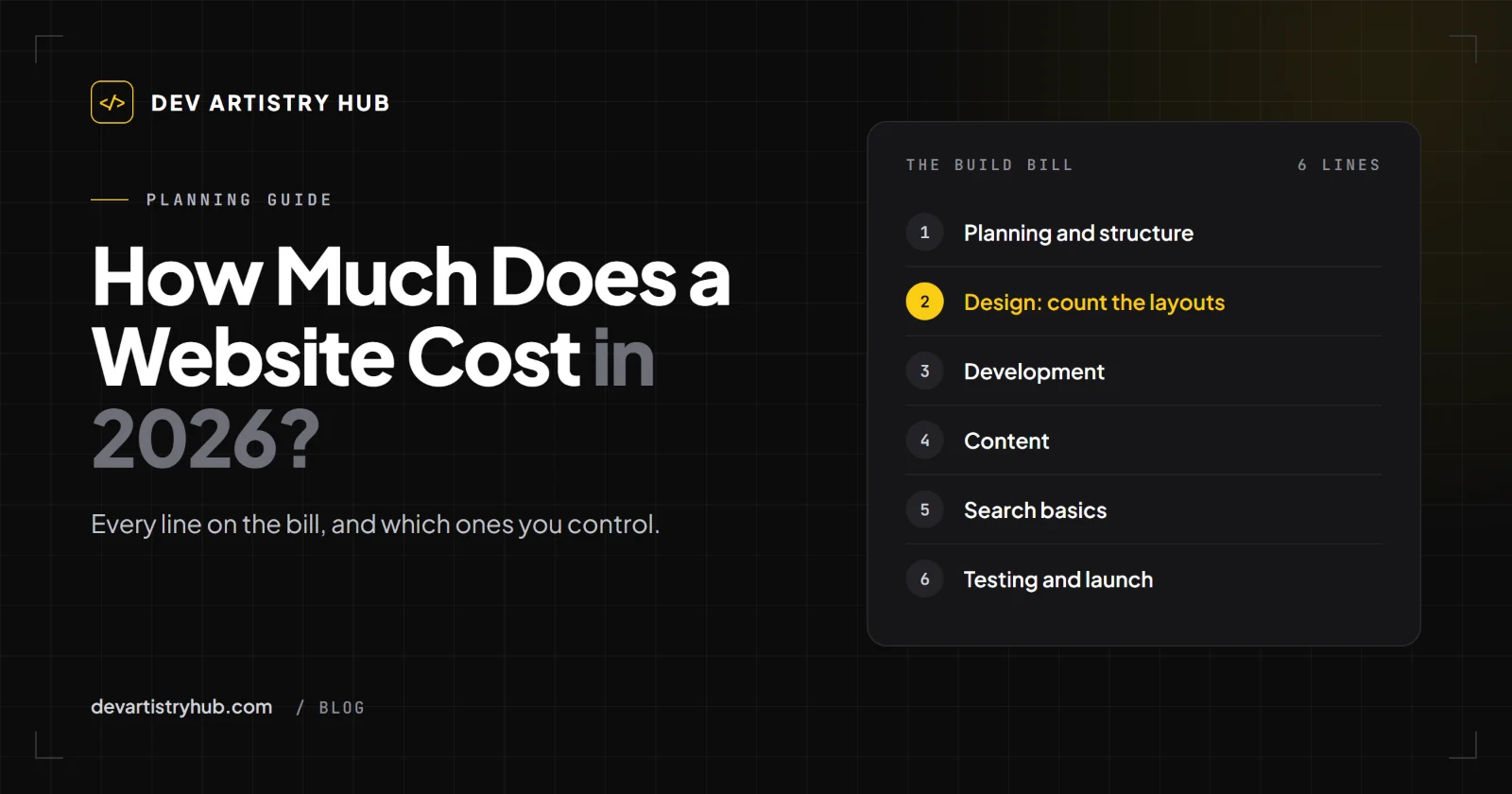
The Build Bill, Line by Line
1. Planning and structure
What it pays for: deciding which pages you need, what each one has to say, and how a visitor moves from the home page to contacting you or buying.
What moves the price: how clear you are about your services before you start. A business that arrives with a list of pages and a few competitors it likes needs far less planning time than one starting from nothing.
2. Design
What it pays for: the look of each page layout, on desktop and phone.
What moves the price: the number of unique layouts, not the number of pages. Twenty service pages that share one layout are one design. A home page, an about page, a services page, a case study and a contact page are five.
Ask every quote: "How many unique page designs does this include?"
3. Development
What it pays for: turning the design into a working site on WordPress, Shopify or custom code, responsive on every screen.
What moves the price:
- The platform. A theme-based WordPress or Shopify build costs less than a custom-coded site, but gives you less control. We compare them in WordPress vs Shopify vs custom development.
- Features. Booking, memberships, multiple languages, a store with variants, integrations with your CRM. Each one is real work and should be listed separately.
- Editability. A site your team can edit safely takes longer to build than one only a developer can change. It is usually worth it.
4. Content
What it pays for: the words and images on every page.
What moves the price: who writes it. Content is the line most often missing from cheap quotes, and the one that delays most launches. If the quote assumes you will supply all text and photos, it should say so.
5. Search basics
What it pays for: page titles, descriptions, headings, a sitemap, clean URLs, image alt text, and making sure Google can index the site.
What moves the price: whether you are replacing an old site. A redesign has to keep old URLs working or redirect them, or you lose the search visibility you already had.
6. Testing and launch
What it pays for: checking forms, checkout, speed and layout on real phones and browsers, then moving the site live.
What moves the price: very little, but it should be on the quote. A quote without a testing line usually means testing is what gets skipped.
The Yearly Basics
These are small, but they never stop:
- Domain name: paid yearly to a registrar.
- Hosting: shared hosting, managed WordPress hosting, or included in a platform like Shopify.
- Platform and apps: Shopify's plan, paid WordPress plugins, premium themes, Shopify apps.
- Email: if your business email is set up on your domain.
Check the current prices on each provider's own pricing page; they change, and they vary by country and plan.
What Changes the Total the Most
If you want to bring a quote down without making the site worse, these are the levers, in order of impact:
- Fewer unique layouts. Reuse one layout for every service page.
- Write your own content, or at least the first draft.
- Launch with the features you need now. Add the booking system or the second language later.
- Use a well-supported theme instead of a fully custom design, if your brand allows it.
- Have your photos ready. Waiting for photos is the most common reason a launch slips.
What a Fair Quote Looks Like
A quote you can trust lists:
- the number of unique page designs;
- the platform and any paid themes, plugins or apps, with who pays for them;
- every feature, one line each;
- who writes and supplies the content;
- what happens to old URLs if you are replacing a site;
- testing on phones and browsers;
- what you own at the end: logins, files, the domain, the hosting account;
- what support is included after launch, and for how long.
If a quote is one line ("Business website: $X"), ask for it broken down. A good developer will happily do it.
Our Own Prices
Every project we build gets a fixed price before work starts, based on the lines above. For ongoing upkeep of a WordPress site, our published plans are a one-off fix at $80, a Care Plan at $160 per month and Business Care at $240 per month; see WordPress maintenance. For a new site, the fastest way to a real number is to send the list of pages and features you need through the contact page.
Frequently Asked Questions
How much does a website cost for a small business?
It depends mostly on the number of unique page layouts, the features and who writes the content. Ask for a quote that lists those three things, and compare quotes line by line rather than by total.
Why are some website quotes so cheap?
Usually because something is missing: content, testing, editability, or support after launch. Sometimes it is a template with your logo on it, which can be the right choice if you know that is what you are buying.
Is it cheaper to build a website myself?
The build is cheaper; your time is not. A website builder is a fair choice for a simple site. When the site has to bring in leads or sales, a developer usually pays for themselves in fewer mistakes.
How long does a website take to build?
Most delays come from content and feedback, not development. Have your text and photos ready and agree on who approves each stage.
Final Takeaway
A website costs whatever its lines add up to, and the lines are knowable. Count the unique layouts, list the features, decide who writes the content, and keep running costs in their own column. Then every quote you collect can be compared fairly, and the cheap one and the expensive one will both make sense.
- #Website Cost
- #Small Business
- #Planning