Web Development Guides
AI SEO vs Traditional SEO: What Actually Changed, What Didn't, and Where the Hype Starts
What is AI SEO, and is it really different? A plain comparison of GEO, AEO and classic SEO, with what Google says and the hype to ignore.
Dev Artistry Hub6 min read
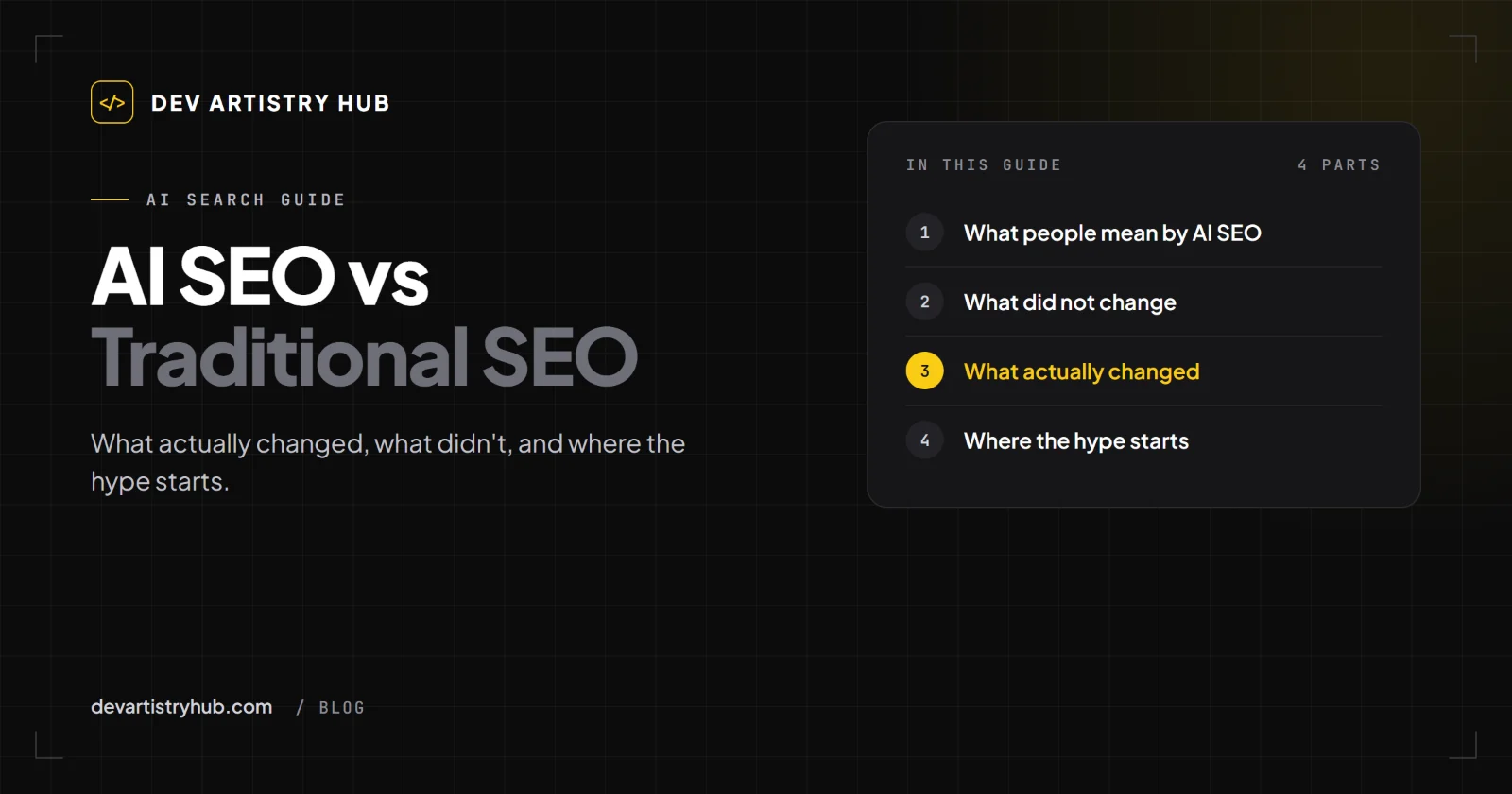
In this article — 9 sections
In the last year, "SEO" quietly got three new names. GEO (generative engine optimisation). AEO (answer engine optimisation). And the one on every agency's homepage: AI SEO.
If you own a business website, you have probably been told that your old SEO is now useless and you need the new kind. Some of that is true. A lot of it is the same work with a new label and a higher price.
This article separates the two. What genuinely changed when people started asking ChatGPT, Gemini and Google's AI Overviews instead of scrolling ten blue links, and what did not change at all.
In short: AI SEO is not a different discipline. It is classic SEO with less tolerance for vague pages. The fundamentals (being crawlable, indexable, fast, and the clearest answer to a real question) still decide whether you are found. What changed is that a summary now sits between you and the searcher, so being cited matters as much as being ranked.
What People Mean by "AI SEO"
The term is used for three different things, and mixing them up is where most confusion starts.
- Optimising to be cited by AI answers. Making your pages the source that Google AI Overviews, AI Mode, ChatGPT search or Perplexity link to when they answer a question. This is what GEO and AEO usually mean.
- Using AI tools to do SEO work. Keyword clustering, writing first drafts of meta descriptions, finding pages with thin content. This is a workflow change, not a new kind of ranking.
- Publishing AI-written content at scale. Generating hundreds of articles to cover every keyword. This is the one that gets sites into trouble.
When someone sells you "AI SEO", ask which of the three they mean. The answer tells you a lot about the agency.
What Did Not Change
Your page still has to be found and indexed
Google's documentation on AI features and your website is blunt: a page "must be indexed and eligible to be shown in Google Search with a snippet", and "there are no additional technical requirements." Everything that stops normal indexing (a stray noindex, a robots.txt block, a page nobody links to) also stops AI citation.
There is no secret format
Google again: "There are no additional requirements to appear in AI Overviews or AI Mode, nor other special optimizations necessary." No special schema, no special file, no magic phrasing. If someone sells you one, ask them to show you where Google says so.
Helpful content still wins
Google's guidance on creating helpful, people-first content has not been replaced. It still asks whether content offers "original information, reporting, research, or analysis" and whether it is "primarily made to attract visits from search engines". Those questions were always the core of good SEO. Now they are harder to fake.
Links, reputation and speed still count
Being mentioned and linked by others, being known for a topic, and having pages that load quickly on a phone all still feed into whether a page is trusted enough to show.
What Actually Changed
Being cited is a second kind of win
On a classic results page, you either ranked or you didn't. In an AI answer, there is a summary and a handful of source links. You can be ranked seventh for the main term and still be the cited source for one part of the answer. That rewards pages that answer one sub-question very well.
Questions got longer and more specific
People type to an AI system the way they would talk to a person: "my Shopify store gets traffic but nobody buys, what should I check first?" Google describes AI Overviews and AI Mode as using "query fan-out", running "multiple related searches across subtopics". Your page competes for those subtopics, not only for a two-word keyword.
Thin pages lost their last excuse
A page that restates the obvious in 1,500 words used to pick up some traffic just by existing. An AI summary now says the obvious part in three lines. What is left for your page is the detail: the steps, the example, the number, the warning from experience.
"Brand" matters more than it used to
AI answers often name businesses. Being consistently described the same way across your site, your Google Business profile, your LinkedIn and the places that mention you makes it easier for any system to understand who you are and what you do.
AI SEO vs Traditional SEO, Side by Side
| Traditional SEO | AI SEO (GEO / AEO) | |
|---|---|---|
| Goal | Rank on the results page | Rank, and be cited inside the answer |
| Unit of competition | A keyword | A question and its sub-questions |
| Technical base | Crawlable, indexable, fast | The same, nothing extra |
| Content that wins | Relevant, thorough | Specific, first-hand, answer-first |
| How you measure it | Rankings, clicks | Clicks, impressions, CTR, brand searches |
| Biggest risk | Thin, keyword-stuffed pages | Thin pages, plus mass AI content |
Where the Hype Starts
Be careful with any of these claims:
- "We guarantee you'll appear in AI Overviews." Nobody can. Google decides per query, and says no special optimisation exists.
- "You need an llms.txt file to be found by AI." It is a proposed convention some sites use. It does no harm, but it is not a ranking requirement for Google, and you should not pay a premium for one text file.
- "We'll publish 100 AI articles a month." Google's guidance on generative AI content says using it to "generate many pages without adding value for users may violate" its spam policy on scaled content abuse.
- "Traditional SEO is dead." The things that make a page crawlable, fast and clear are exactly what AI systems rely on.
Using AI Tools for SEO, Safely
AI tools are genuinely useful for the dull parts of SEO: grouping hundreds of search terms into topics, spotting pages with no meta description, drafting an outline. The rule Google gives is simple: "It is critical to manually factcheck and review all AI-generated content for accuracy and trustworthiness before publishing." That also applies, Google says, to metadata such as titles, descriptions and image alt text.
A workable split:
- Let AI do: research grouping, first drafts of outlines, finding gaps in a page, rewriting a meta description you then check.
- Do yourself: the claims, the numbers, the examples, the advice. Anything a customer might act on.
What to Do This Quarter
- Fix the base. Sitemap submitted, no accidental
noindex, pages load quickly on a phone. - Rewrite the first paragraph of your top pages so it answers the main question directly.
- Add a heading for each sub-question people ask around your service.
- Add one first-hand example per page: a project, a mistake, a result you can show.
- Make the business consistent everywhere: the same name, description and services on your site and your profiles.
- Measure in Search Console over 8 to 12 weeks, comparing clicks, impressions and CTR, not a single day.
If your site needs a cleaner structure before any of this can work, that is what a careful website redesign is for: new design, the same URLs and content kept findable.
Frequently Asked Questions
What is AI SEO, in one sentence?
Making your website the clearest and most trustworthy source for a question, so that both search results and AI-generated answers show it and link to it.
Is GEO different from SEO?
GEO is a name for the part of SEO focused on being cited by AI answers. The technical and content fundamentals are the same.
Do I need new tools for AI SEO?
No. Google Search Console is free and shows AI Overview traffic inside the normal Web search results. Many AI SEO tools help with research, but none can make Google cite you.
Will AI-written content rank?
Google does not ban AI-assisted content. It asks that content meet the same quality standards and be fact-checked. Mass-produced pages that add nothing are the problem, however they are written.
Final Takeaway
AI SEO is real, but it is not new magic. It is the old rules enforced more strictly. Be findable, be fast, answer the question first, and put something on the page that only you could have written. Skip anyone who sells guarantees.
- #SEO
- #AI Search
- #Content