Web Development Guides
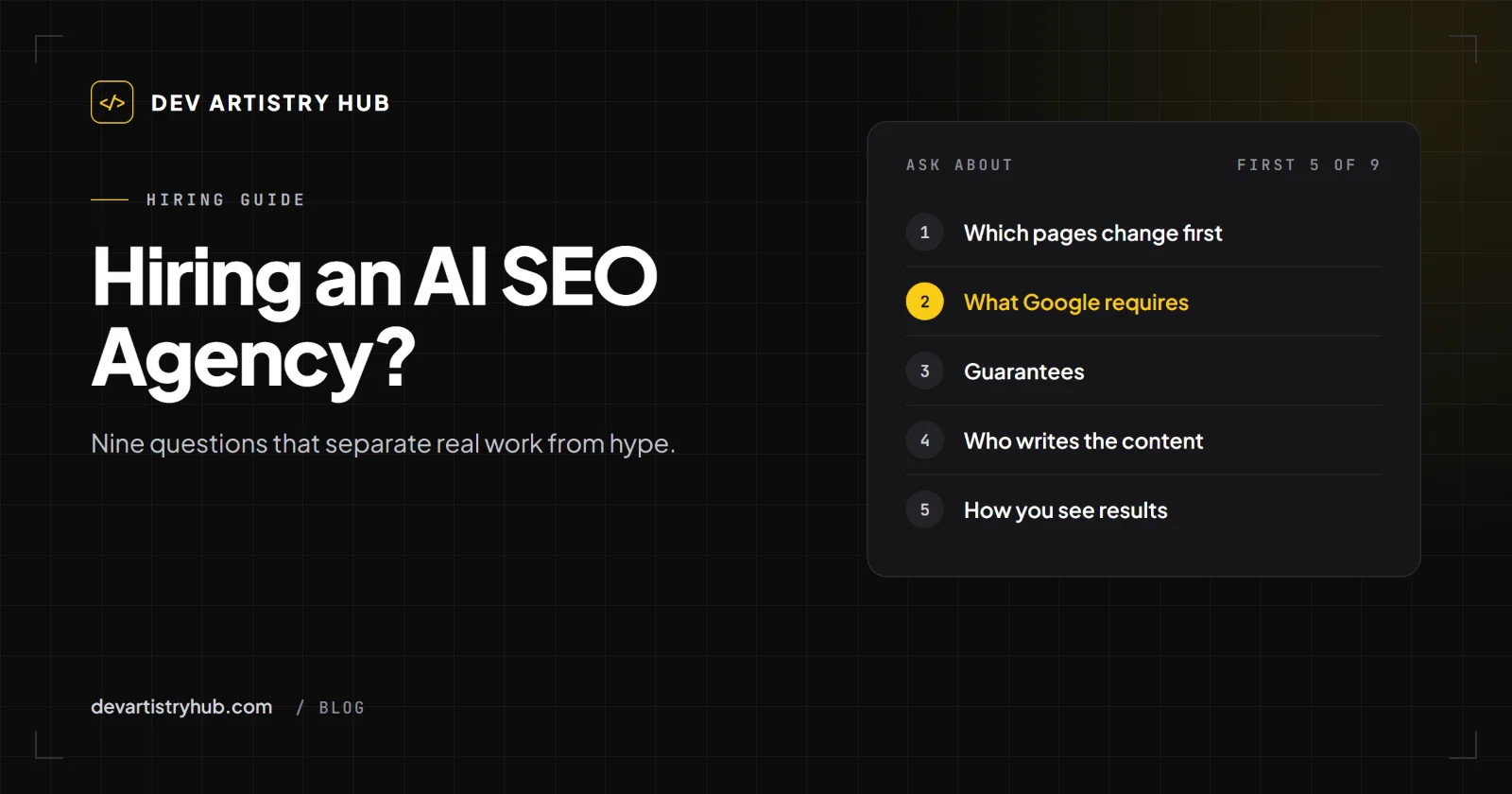
Hiring an AI SEO Agency? 9 Questions That Separate Real Work From Hype
Nine questions to ask an AI SEO agency before you sign, the answers that should worry you, and what good AI SEO services look like.
Dev Artistry Hub5 min read
In this article — 13 sections
- 1. "Which of my pages will you change first, and why?"
- 2. "What does Google say is required to appear in AI Overviews?"
- 3. "Can you guarantee placement in ChatGPT or AI Overviews?"
- 4. "How many articles will you publish, and who writes them?"
- 5. "What will you need from me?"
- 6. "How will I see results myself?"
- 7. "What technical problems did you find on my site?"
- 8. "What happens to the work if I stop paying?"
- 9. "Show me a page you improved, before and after."
- What Good AI SEO Work Usually Includes
- When You Might Not Need an Agency
- Frequently Asked Questions
- Final Takeaway
A year ago, the same agencies were selling "SEO packages". Now the page says AI SEO services, the price is higher, and the promise is that your business will show up when people ask ChatGPT or Google's AI Overviews for a recommendation.
Some of these agencies do excellent work. Some have changed the word on the homepage and nothing else. The trouble is that from the outside, in a sales call, both sound the same.
These nine questions are the ones that make the difference visible. You do not need to understand SEO to ask them. You only need to listen to how specific the answers are.
In short: good AI SEO work looks like good SEO work: technical fixes you can see, content built around real questions, and reporting in Search Console you can check yourself. Be wary of guarantees, secret methods and content volume as the main promise.
1. "Which of my pages will you change first, and why?"
A real agency has looked at your site before the call, or asks to. They should be able to name pages: "Your services page ranks for X but answers it in the fourth paragraph" or "Your blog has eight posts that compete for the same search."
Worrying answer: a list of deliverables that would fit any business. "Keyword research, on-page optimisation, AI content, link building."
2. "What does Google say is required to appear in AI Overviews?"
This is a knowledge check. Google's own page, AI features and your website, says: "There are no additional requirements to appear in AI Overviews or AI Mode, nor other special optimizations necessary." A page has to be indexed and eligible for a normal snippet.
Good answer: "Nothing special. We make sure you're indexed and eligible, then make your pages the best answer to specific questions."
Worrying answer: a proprietary method, a special file, or a schema type that "unlocks" AI citations.
3. "Can you guarantee placement in ChatGPT or AI Overviews?"
The honest answer is no. AI answers change by query, by user and by day. Nobody controls them.
Worrying answer: any guarantee, especially one tied to a number of "AI mentions".
4. "How many articles will you publish, and who writes them?"
Content volume is the easiest thing to sell and the easiest thing to fake with AI. Google's guidance on generative AI content warns that using it to "generate many pages without adding value for users may violate" its spam policy, and says it is "critical to manually factcheck and review all AI-generated content" before publishing.
Good answer: fewer pieces, each based on questions your customers actually ask, reviewed by a person, with input from you on the parts only you know.
Worrying answer: "30 AI-optimised articles a month" with no mention of who checks them.
5. "What will you need from me?"
This one surprises people, but it is a strong signal. Content that wins citations needs first-hand detail: a job you finished, a mistake you see often, a question a customer asked last week. Google's helpful content guidance asks whether a page offers "original information, reporting, research, or analysis".
Good answer: "An hour a month with you, plus access to your reviews, FAQs and past projects."
Worrying answer: "Nothing, we handle everything." If they never ask you anything, everything they publish will be generic.
6. "How will I see results myself?"
You should not have to trust a PDF. Google says traffic from AI features is included in Search Console's Performance report, under the Web search type. An agency should be happy to work from your own Search Console account, which is free.
Good answer: "We'll use your Search Console and show clicks, impressions and CTR for the pages we changed, compared with before."
Worrying answer: a private dashboard with an "AI visibility score" you cannot verify anywhere else.
7. "What technical problems did you find on my site?"
A lot of lost visibility is technical: pages accidentally set to noindex, a sitemap that lists the wrong URLs, a redesign that broke old links, a slow mobile site. These are not glamorous, but fixing them often helps more than any content.
Good answer: specific issues, with the page they found them on.
Worrying answer: "Your site is fine technically, the problem is content." Possible, but they should have checked.
8. "What happens to the work if I stop paying?"
Some agencies host content on their own platforms, or use plugins and scripts that stop working when the contract ends.
Good answer: "Everything lives on your site, in your account. If you leave, it stays."
Worrying answer: anything vague about ownership of the content or the accounts.
9. "Show me a page you improved, before and after."
Not a logo wall. One page, what it looked like, what they changed, and what happened in Search Console over the following months.
Good answer: a real example, with the boring details.
Worrying answer: big percentages with no page, no dates and no way to check.
What Good AI SEO Work Usually Includes
If the answers above are good, the work itself should look something like this:
- A technical check: indexing, sitemap,
noindex, robots.txt, redirects, mobile speed. - A question map: the real questions your customers ask, grouped by topic and by service.
- Answer-first rewrites of your most important pages.
- New content that is specific: fewer, better pieces with your experience in them.
- Consistent business information across your site and profiles.
- Reporting from your own Search Console, compared quarter over quarter.
When You Might Not Need an Agency
If your site has fewer than 20 pages and you serve a local or niche market, you may get further by fixing the basics yourself: answer the main question at the top of each service page, add a short FAQ with the questions you hear on calls, and check Search Console once a month.
Where a developer helps is the technical layer: a site that is slow, built on a theme that fights you, or losing pages to errors. That is the kind of work we do in website redesign and WordPress maintenance.
Frequently Asked Questions
What is the difference between an AI SEO agency and a normal SEO agency?
Often only the name. A good one of either kind will work on being found, being trusted and being the clearest answer. The AI part should mean they also think about being cited in AI answers, not that they publish AI content in bulk.
Are AI SEO services worth the higher price?
Only if the work is more specific than ordinary SEO. Pay for analysis of your site, technical fixes and content with real expertise, not for the word "AI".
Can I do AI SEO myself?
The basics, yes: answer-first pages, clear headings for each question, a real example on each page, and monthly checks in Search Console.
Final Takeaway
The best AI SEO agencies sound almost boring on a sales call: they talk about your pages, your questions and your Search Console. The risky ones talk about guarantees, secret methods and article counts. Ask the nine questions, and let the specificity of the answers decide.
- #SEO
- #AI Search
- #Hiring