Web Development Guides
AI SEO Tools for Small Business: What They Do Well, Where They Mislead, and the Free Setup to Start With
Do AI SEO tools work for a small business? What they do well, where they mislead, the free tools to start with, and a weekly workflow.
Dev Artistry Hub5 min read
In this article — 8 sections
Search for "best AI SEO tools" and you will find long lists, each one ranking twenty products, most of them with an affiliate link. The lists rarely tell you the part that matters for a small business: which jobs these tools actually do well, which numbers they make up, and whether you need a paid plan at all.
This is not another ranked list. It is a guide to the categories of AI SEO tools, what each is good and bad at, and a free starting setup that covers most of what a small business website needs.
In short: AI SEO tools are good at speed (grouping keywords, drafting outlines, spotting thin pages) and bad at truth (their traffic estimates are estimates, and their writing needs checking). Start with free tools from Google, add a paid tool only for a job you do every week.
What AI SEO Tools Are Actually Good At
Grouping search terms into topics
Give an AI tool a list of a few hundred searches and it will cluster them into themes in seconds. That used to take an afternoon in a spreadsheet. It is one of the most useful things AI does for SEO.
Drafting outlines and meta descriptions
A first draft of a page outline or a meta description, which you then edit, saves time. Google's guidance on generative AI content says to "manually factcheck and review all AI-generated content", and adds that this "also applies to metadata like" titles, descriptions, structured data and image alt text.
Finding gaps in a page
Paste your page and the questions people ask about the topic, and ask which questions the page does not answer. That turns into a to-do list.
Spotting technical issues at scale
Crawl-based tools find missing titles, broken links, duplicate pages and slow templates across a whole site.
Where They Mislead
Traffic and volume numbers are estimates
Third-party keyword volumes and traffic estimates are modelled, not measured. Different tools give different numbers for the same keyword. Use them to compare one keyword with another, not as a forecast.
"AI visibility scores" are not a Google metric
Many tools now sell a score for how often you appear in AI answers. Google says traffic from its AI features is reported in Search Console's Performance report, within the Web search type, and that no special optimisation is required to appear. A proprietary score may be interesting, but it is not something Google uses.
AI-written content is not automatically safe
Google warns that using generative AI to "generate many pages without adding value for users may violate" its spam policy on scaled content abuse. A tool that publishes for you at volume puts that risk on your site, not the tool's.
Generic advice dressed as analysis
"Add more keywords to your H2s" and "increase word count to 2,000" are templates, not insight. The useful recommendations are specific to your page and your searchers.
The Free Setup to Start With
For most small businesses, this covers the essentials at no cost:
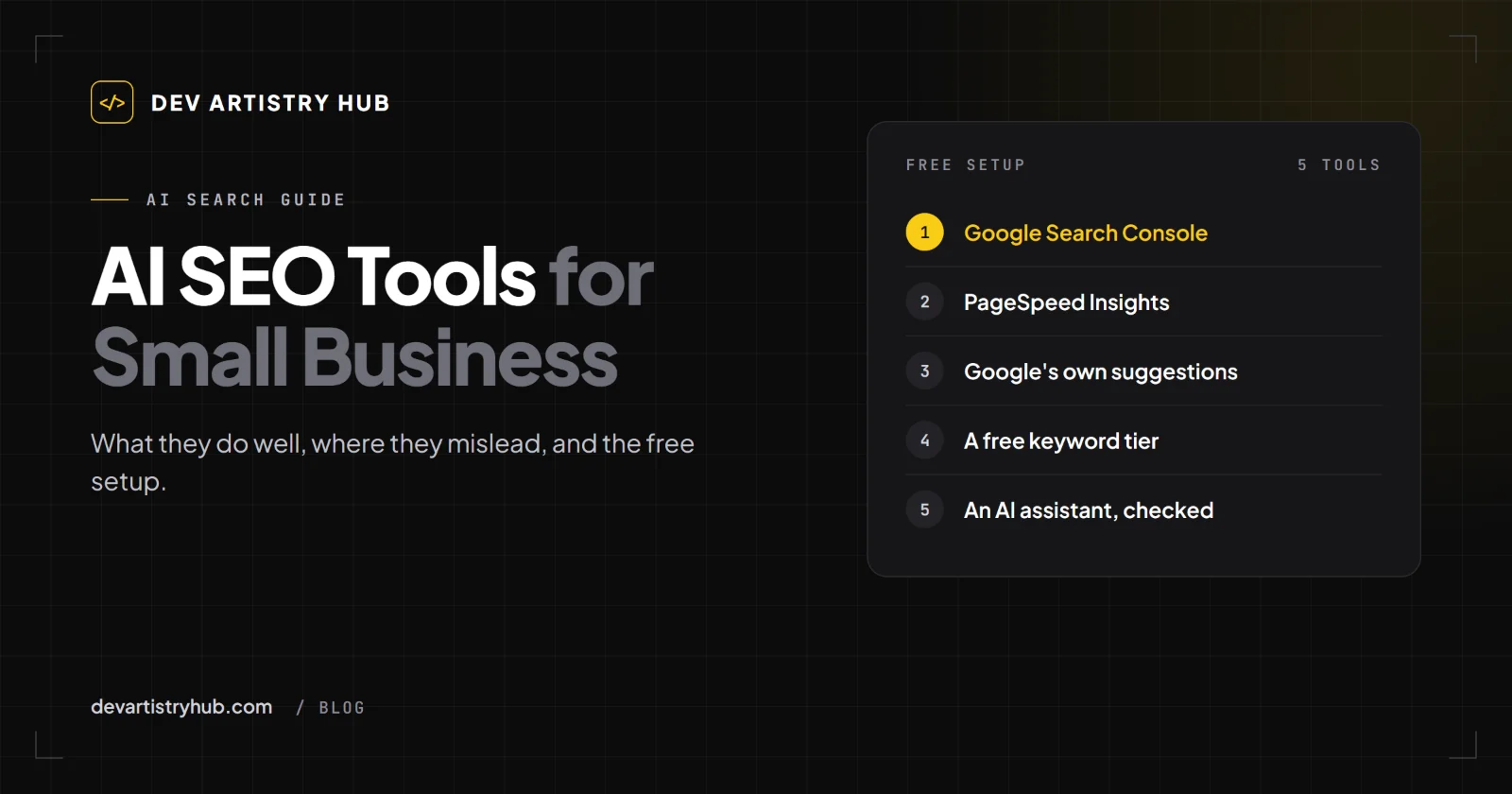
- Google Search Console. What you actually rank for, real clicks and impressions, indexing problems, Core Web Vitals. The only source of truth for how Google sees your site.
- PageSpeed Insights. Speed on mobile and desktop for any page.
- Google's own autocomplete and "People also ask". The real questions people type, free and current.
- A free tier of a keyword tool. Most offer a few free searches a day, enough to check the volume of a handful of topics.
- A general AI assistant. For clustering, outlines and first drafts, which you then check.
A Weekly Workflow That Needs No Paid Plan
Monday, 20 minutes: Search Console → Performance. Compare the last 28 days with the previous 28. Note pages with falling clicks and queries with rising impressions.
Tuesday, 30 minutes: pick one page from that list. Collect the questions around its topic from autocomplete and "People also ask". Ask an AI assistant which of them the page does not answer.
Wednesday, 1 hour: rewrite the first paragraph to answer the main question directly, and add headings for the missing questions. Add one first-hand example.
Thursday, 15 minutes: check the page in PageSpeed Insights on mobile. Note anything obviously heavy.
Friday, 10 minutes: log what you changed and the date, so you can compare in Search Console in two to three months.
One page a week is about fifty a year, which is more improvement than most small sites get.
When a Paid Tool Is Worth It
Pay when you do a job every week that a free tool cannot do well:
- tracking rankings for many keywords across several locations;
- monitoring competitors' new pages and links;
- crawling a large site regularly;
- managing SEO for several client sites.
Before paying, ask: which decision will this tool's data change? If you cannot name one, keep the free setup.
What No Tool Can Do for You
- Know your business. The examples, the mistakes you see, the answers you give on calls: that is what makes a page worth citing. Google's helpful content guidance asks whether content provides "original information, reporting, research, or analysis".
- Fix a slow or broken site. Tools can find problems; someone has to fix the theme, the hosting or the code.
- Guarantee AI citations. Nobody controls those.
When the tools keep pointing at technical problems you cannot fix yourself, such as a slow theme, broken templates or a site that is hard to edit, that is where a developer helps. It is the kind of work we do in website redesign and WordPress maintenance.
Frequently Asked Questions
What are the best AI SEO tools for a small business?
Start with free ones: Google Search Console, PageSpeed Insights, Google's own search suggestions and a general AI assistant. Add a paid tool only for a weekly job the free tools cannot do.
Are free AI SEO tools enough?
For most small business websites, yes. The data that matters most, from Search Console, is free.
Can AI SEO tools write my blog posts?
They can draft. Google asks that AI content be fact-checked and warns against mass-producing pages without value. Your experience is what makes the post worth reading.
Do AI SEO tools show if I appear in Google AI Overviews?
Some estimate it. Google itself includes AI feature traffic in Search Console's Web search results rather than a separate report.
Final Takeaway
AI SEO tools make the slow parts of SEO fast. They do not make the important parts true. Use free Google tools as your source of truth, use AI to save time on grouping and drafting, check everything it writes, and pay for a tool only when it changes a decision you make every week.
- #SEO
- #AI Search
- #Tools